Best Microscope for Mobile Repairing: Trinocular, Binocular or Digital
17 November 2026 · LightspeedTools team
Short answer: The best microscope for mobile repairing is a stereo (not compound) zoom microscope with roughly 7–45X or 7–50X continuous zoom, a long working distance, a good LED ring light and a solid stand. For most shops a trinocular model is the smartest buy, because the third port takes a camera for teaching, customer proof and documentation. A binocular suits a tight budget, and a digital microscope works as an inspection screen but not as your main soldering scope.
That answer covers most shops. The rest of this guide explains what each spec actually changes at the bench, compares the three types side by side, and matches them to the kind of work you do.
Why phone board work needs a stereo microscope
Modern phone boards are stacked, double-sided and packed with 0201 and 01005 passives, underfilled ICs and fine-pitch connectors. You cannot reball a chip, lift a pad or trace a short on that by eye or with a loupe. A stereo microscope gives you two slightly different views, one per eye, so you see depth. Depth is what lets you judge how high your tweezers are above a component and when your iron tip actually touches the joint.
Compound microscopes (the type used in labs with slides) give high magnification but almost no working room and a flat image. They are the wrong tool for repair. Everything below is about stereo zoom microscopes.
The specs that matter, and what they do at the bench
Magnification: more is not better
Most board work happens between about 7X and 20X. You use the low end to find your place on the board and the middle range for soldering and reballing. Higher zoom, up to 40X or more, is for checking a cracked joint, a damaged trace or corrosion under a chip edge. Above that, the field gets small, the image gets darker and the depth of field gets shallow, so you spend more time refocusing than working.
Look for continuous zoom rather than fixed steps. Ranges like 7–45X, 7–50X or 6.5–58X are common on repair-grade scopes. Remember that total magnification depends on the eyepieces and any auxiliary objective lens fitted, so the same body can be set up for different ranges.
Working distance: room for your iron and hot air
Working distance is the gap between the bottom of the objective lens and the board while in focus. You need enough room to get a soldering iron, hot air nozzle and tweezers underneath without hitting the lens or heating it. A standard stereo head usually gives around 100mm. A 0.5X auxiliary objective lens roughly doubles that working distance and widens the field of view, at the cost of halving magnification. Many technicians fit one permanently for hot air work.
Field of view: how much board you see
Field of view is the diameter of the area you can see. A wide field at low zoom lets you see a whole section of a logic board and orient yourself before zooming in. Wide-field eyepieces (often marked WF10X or WF20X) and a 0.5X objective both widen it. A small field at high zoom is normal; just make sure the low end is wide enough to work comfortably.
Optical quality and parfocal zoom
Two things separate a good scope from a frustrating one. First, image sharpness and color across the whole field, not just the center. Second, parfocal behavior: once focused at high zoom, the image should stay in focus as you zoom out. A scope that loses focus every time you change zoom slows down every job.
Lighting: the cheapest upgrade with the biggest effect
Most problems people blame on optics are really lighting problems. A dimmable LED ring light that mounts around the objective gives even, shadow-free light, which is what you want for most board work. Adjustable or segmented rings let you light from one side to bring out the edge of a solder joint or a hairline crack. A model like the MaAnt 144-bead USB ring light with cable control or the Mechanic LS720 / LS360 ring light series is an easy way to brighten an older scope. Browse more in our LED ring lights range.
Trinocular port and camera
A trinocular head has a third optical port on top for a camera. On most repair scopes it is a C-mount, often paired with a 0.5X CTV adapter so the camera sees roughly what your eyes see. With a camera attached you can:
- Show customers the corrosion or damaged pad before you quote, which builds trust and closes jobs.
- Record repairs for warranty claims and your own records.
- Train junior technicians on a monitor while you work.
- Make video content for your shop's social channels.
Some trinocular heads split light between the eyepieces and the camera at all times; others use a lever to switch. Either works for repair. A purpose-made camera such as the MaAnt XJ-03 microscope camera is simpler than adapting a general webcam. See our microscope cameras for more options.
Stand and boom
The stand decides whether the image is steady and whether the scope fits your bench. A heavy pillar stand is stable and compact. A boom or articulating arm lets you swing the head over a larger area and push it aside when not in use. Check the focus rack moves smoothly and holds its position without drifting down. Wobble at 40X is very visible, so a cheap stand can waste a good head. If your current stand is the weak point, upgrading it is often cheaper than replacing the whole scope.
Trinocular vs binocular vs digital microscope
| Feature | Trinocular stereo | Binocular stereo | Digital (screen-based) |
|---|---|---|---|
| Depth perception | Yes, true 3D through eyepieces | Yes, true 3D through eyepieces | No, flat image on a screen |
| Best for | Microsoldering, reballing, shops that teach or film | Microsoldering on a budget | Inspection, showing customers, light work |
| Camera option | Built-in third port | None without workarounds | Built in |
| Hand-eye lag | None | None | Possible slight delay on some models |
| Working distance | Long, extendable with 0.5X lens | Long, extendable with 0.5X lens | Varies widely by model |
| Eye fatigue on long shifts | Low when set up correctly | Low when set up correctly | Higher for some users looking at a screen |
| Upgrade path | Add camera, monitor, lenses | Add lenses and lights | Limited |
| Relative cost | Highest | Middle | Lowest to middle |
Trinocular: the default for working shops
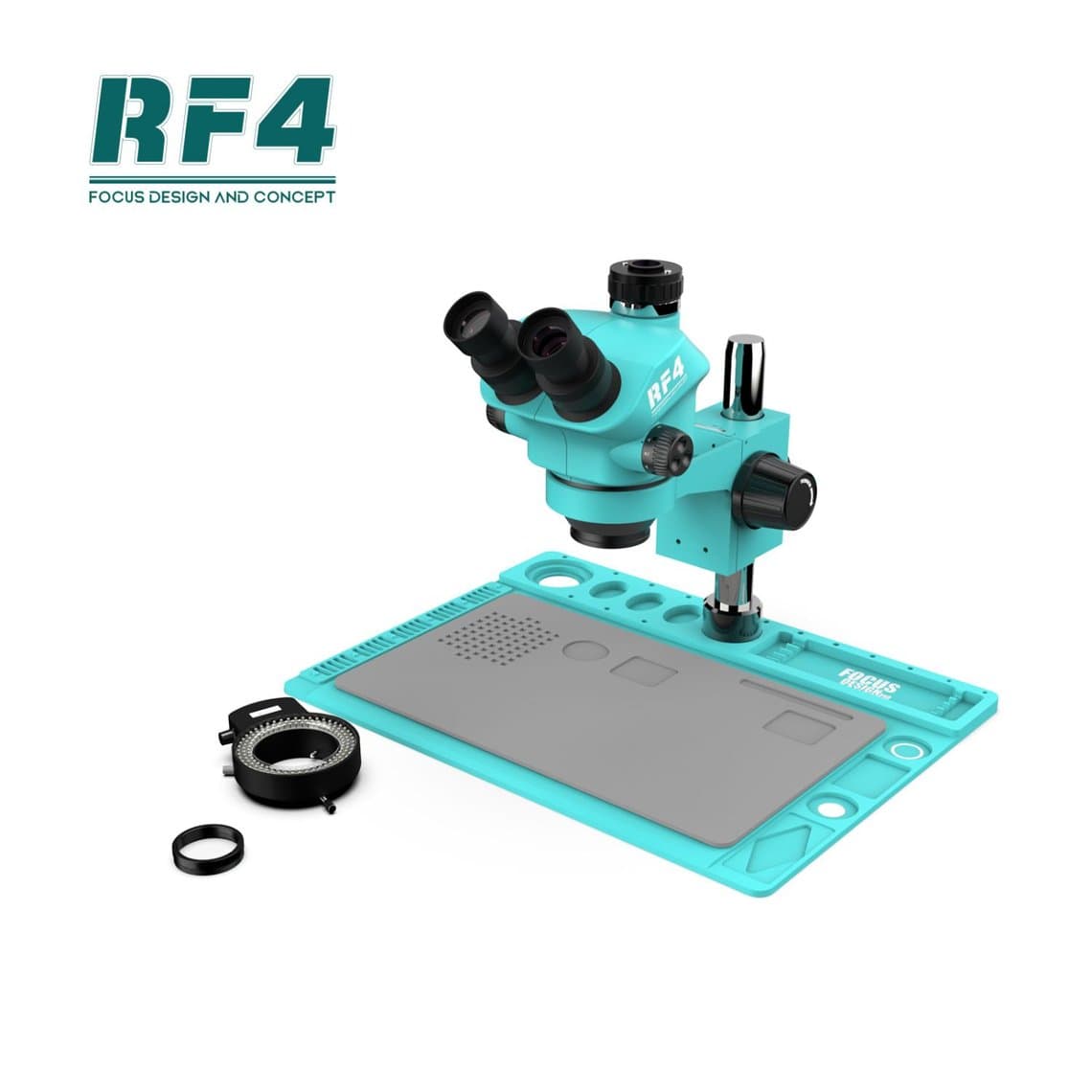
If you do board-level repair every day, buy a trinocular. You get the same 3D view as a binocular plus a camera port you will almost certainly use. Popular repair-grade options include the Kaisi TX-350E V1.2 trinocular, the RF4 7–50X trinocular and the Mechanic Robot 7060T 7–60X. If you want a wider zoom range for fine inspection, look at the YCS M.Y 85 Ultra 6.3–68X. Compare them all in trinocular microscopes.
Binocular: solid optics, lower cost
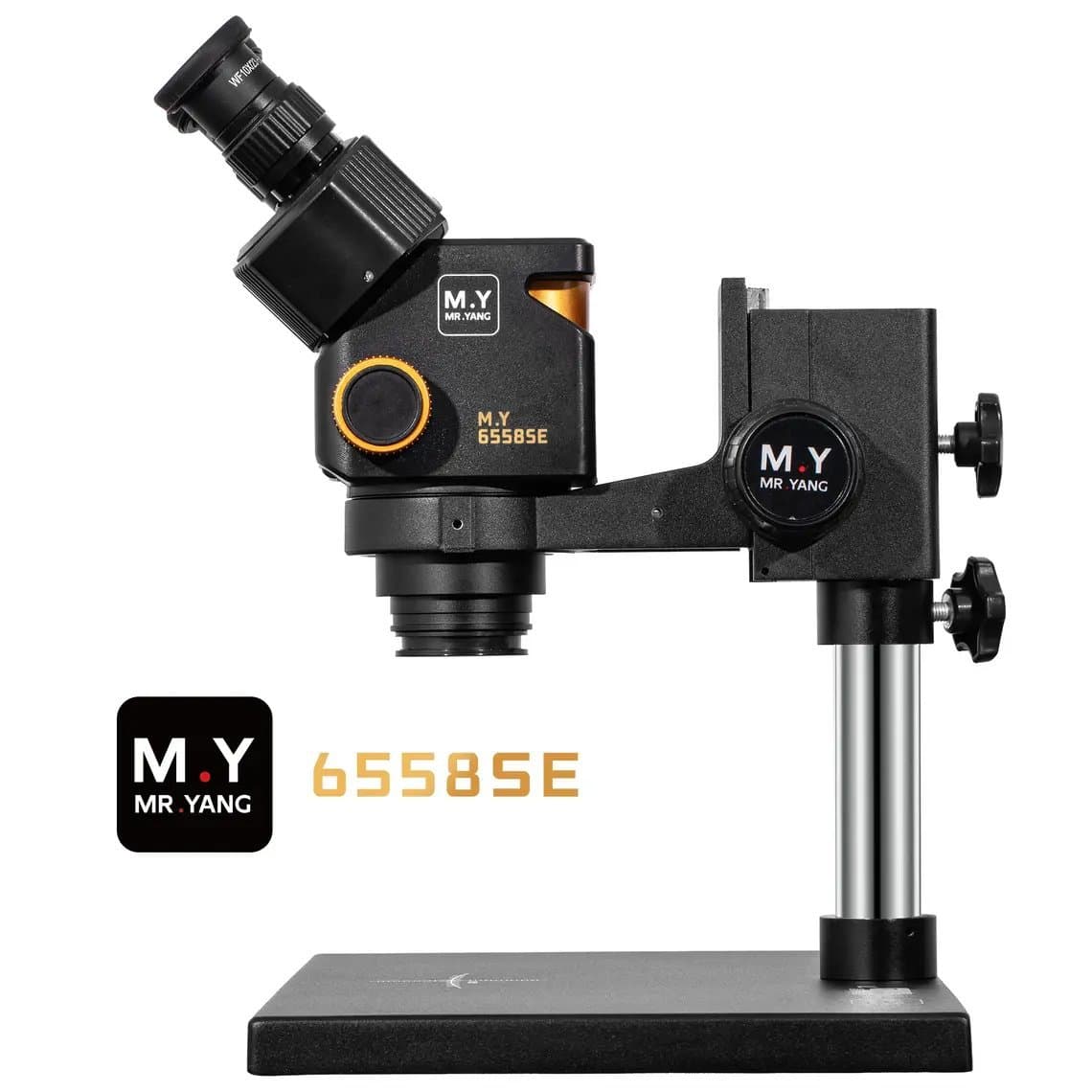
A binocular stereo scope does the soldering job just as well. You lose the camera port, which matters less for a one-person shop that does not film or train. The Kaisi TX-50s binocular is a common starting point, and the YCS M.Y 6558SE 6.5–58X binocular gives a wider zoom range. See the full range of binocular microscopes.
Digital: inspection and the front counter
A digital microscope shows the image on a built-in or external screen. It is useful at the front counter, for quick checks of charging ports and connectors, and for showing a customer liquid damage. For actual microsoldering most technicians find the flat image and lack of depth slow them down, so treat a digital scope as a second tool. Options are in digital microscopes.
What to buy for which shop
- Screen and battery swaps only, little board work: a digital microscope or an entry binocular is enough for inspection and connector checks.
- Starting board repair: a binocular or entry trinocular with a 0.5X objective and a dimmable ring light. Spend on a stable stand before chasing higher zoom.
- Full microsoldering and reballing shop: a trinocular with continuous parfocal zoom, a boom or heavy pillar stand, a ring light and a camera to a monitor.
- Training centre or multi-bench shop: trinoculars on every bench so trainees can follow on a screen, plus one digital scope at the counter.
- Data recovery and fine inspection: a trinocular with a wide zoom range and good edge-to-edge sharpness at the top end.
Setup tips that make any microscope better
- Set the eye spacing (interpupillary distance) so you see one round image, not two.
- Adjust the diopter. Focus at high zoom with one eye, then set the other eyepiece's diopter ring until both match. Skipping this is a common cause of headaches.
- Focus at high zoom, then zoom out. On a parfocal scope the image stays sharp across the range.
- Sit at the right height. Your back should be straight and your eyes level with the eyepieces without craning your neck. Raise the scope or chair rather than hunching.
- Protect the objective. Hot air and flux fumes cloud lenses over time. A clear protective lens or the extra distance from a 0.5X objective helps, and fume extraction helps more.
- Clean lenses properly. Use a blower first, then lens tissue with a small amount of lens cleaner. Never wipe a dry, dusty lens.
Questions
What magnification do I need for mobile phone repair?
A continuous zoom of roughly 7X to 45X covers nearly all phone board work. Most soldering and reballing is done between about 10X and 20X, and the higher end is for inspecting joints and traces. Very high zoom is rarely needed and usually means a darker image and shallower focus.
Is a trinocular microscope worth it over a binocular?
For most repair shops, yes. The optics for soldering are the same, but the third port lets you add a camera to show customers damage, record repairs and train staff. If you work alone and never plan to film, a good binocular is a reasonable saving.
Can I use a digital microscope for microsoldering?
You can, but most technicians find it harder. A screen gives a flat image with no depth, so judging tool height and contact is slower. Digital scopes are better for inspection and customer demonstrations, with a stereo scope for the actual soldering.
What does a 0.5X auxiliary lens do?
It roughly doubles the working distance and widens the field of view while halving the magnification. That gives more room for hot air and the iron and keeps heat further from the lens. Many shops leave one fitted permanently and adjust zoom to compensate.
Ready to choose? Compare every model in our microscopes for phone repair category, add lights and cameras in one order with quick order, and see wholesale pricing, which unlocks after $500 of purchases. Not sure which head or stand suits your bench? Contact us and we will help you pick.