Battery Health Programmer Compared: JCID, i2C, Mijing and Qianli
17 November 2026 · LightspeedTools team
Short answer: A battery health programmer reads the data stored on an iPhone battery's management chip and writes it to a replacement, so the phone can show battery health and cycle count again after a battery swap. Tools from JCID, i2C, Mijing and Qianli all do this on supported models, usually with a separate battery flex or tag-on board. They differ mainly in model coverage, what extra repairs they handle and what add-ons you have to buy, so always check each tool's current compatibility list.
Why battery health shows "Service" or "Unknown" after a replacement
Every iPhone battery has a small circuit board, the battery management system (BMS), attached to the cell. It protects the cell and stores data such as cycle count, design capacity, and an identity the phone can check. On recent iPhones, the phone compares that battery data with what it expects. When a non-Apple battery or an unpaired cell is fitted, iOS may show a battery service message, list the battery as an "Unknown part" in Settings, or hide the battery health percentage. The exact message depends on the model and iOS version.
The battery still charges and powers the phone. What the customer loses is the health reading, and many customers read the notice as a sign of a bad repair. We explain the wider background in our article on the "Unknown part" message on iPhone. Programmers are the main tool shops use to restore the health display on supported models.
The two main approaches
1. Programmer plus battery flex or tag-on board
This is the most common method. You read the data from the customer's original battery with a programmer, then fit a new cell that carries a programmable board, either a battery repair flex made for that programmer or a tag-on board attached to the new cell. The programmer writes the original data to the new board, and on supported models the phone shows battery health again. Many tools can also adjust the cycle count and health values stored on the board.
The advantages are speed and lower risk: you never take the original BMS off its cell. The downside is the ongoing cost of flexes or boards for each job, and the fact that support depends on the model and the tool's firmware.
2. Moving the original BMS onto a new cell
The second method keeps the original battery's board and transfers it onto a fresh cell, normally by spot welding the nickel tabs. Because the phone sees its own original BMS, this can avoid the notice on some models without a programmer. It needs a spot welder, practice and great care. Shorting or overheating a lithium cell can cause fire, and a damaged BMS cannot be recovered. Some shops then use a programmer to reset the cycle count or health on the transferred board.
Some newer batteries are sold with a board designed so you do not need to move the original flex. These still need a compatible programmer and only work on the models they are made for.
What a battery health programmer does
Most programmers in this category offer the same core battery functions, with differences in how they handle them:
- Read battery data from the original battery: serial, cycle count, capacity values and health.
- Write data to a new battery board or flex.
- Edit cycle count and health on the board, where the tool supports it.
- Back up and restore data so you can rewrite it if a job goes wrong.
Most of these tools are multi-function. The same box usually handles True Tone transfer for screens, and some cover Face ID dot projector repair, earpiece and light sensor data, or camera modules with the right add-on flex. That is why the real comparison is not just "does it do batteries" but "what else will I use it for, and what will the add-ons cost".
Battery health programmers compared
The table below uses only what each product title states. Model support changes with firmware updates and differs by function, so confirm the current compatibility list for the exact model and repair before buying.
| Tool | Battery function | Extra flex or board needed | Other functions (from title) | Models stated |
|---|---|---|---|---|
| JCID V1S Pro | Yes | Yes, function modules and battery boards sold separately | Screen True Tone, Face ID, battery | Check JCID's current list |
| i2C i6S | Yes | Yes, flexes per function | True Tone, battery, dot matrix | iPhone 6–13 (per title) |
| Mijing ZH01 | Yes | Yes, battery repair flex | Dot matrix, battery, camera flexes available | Check Mijing's current list |
| Qianli iCopy series | Yes | Yes, battery board | LCD True Tone, light sensor, battery | Check Qianli's current list |
JCID V1S Pro
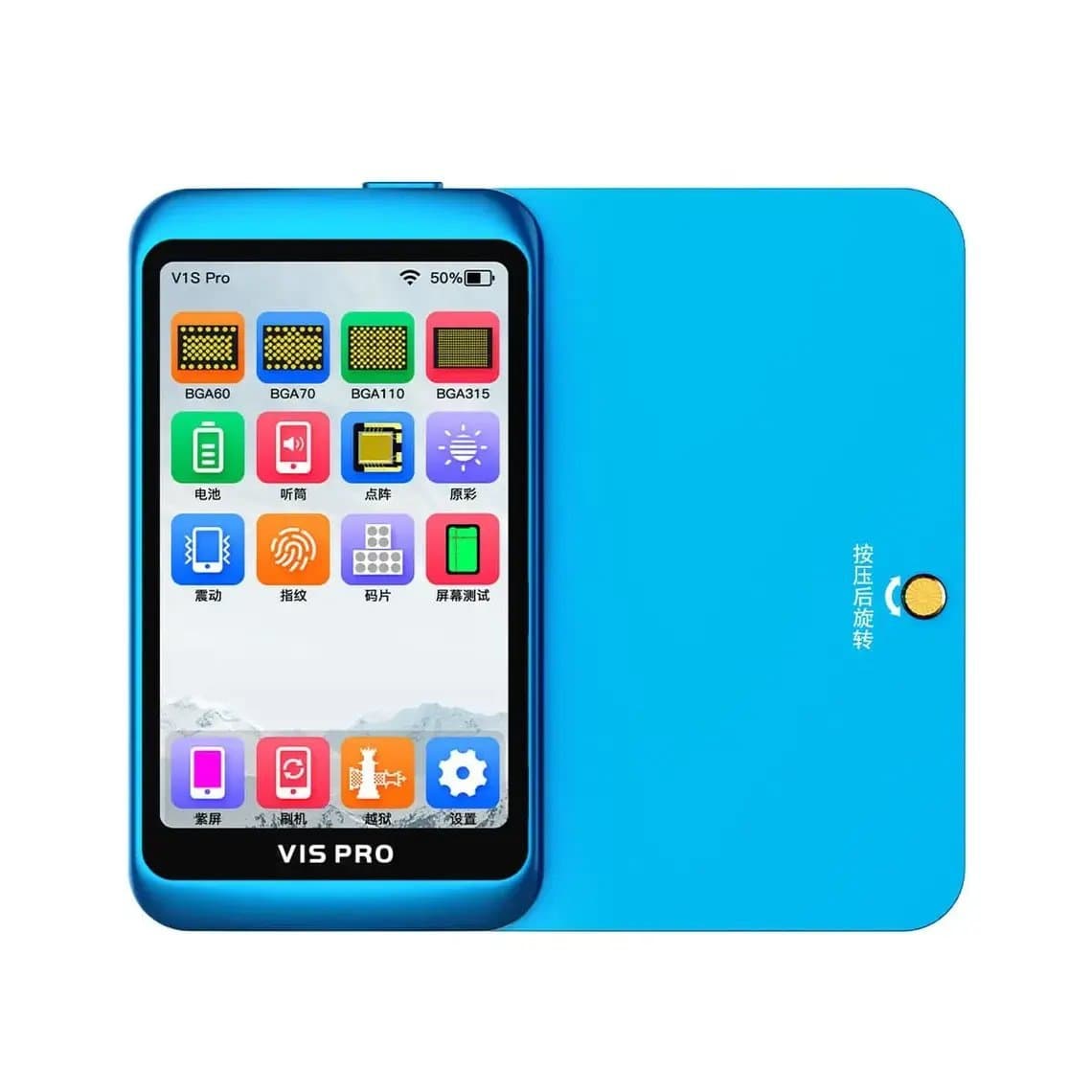
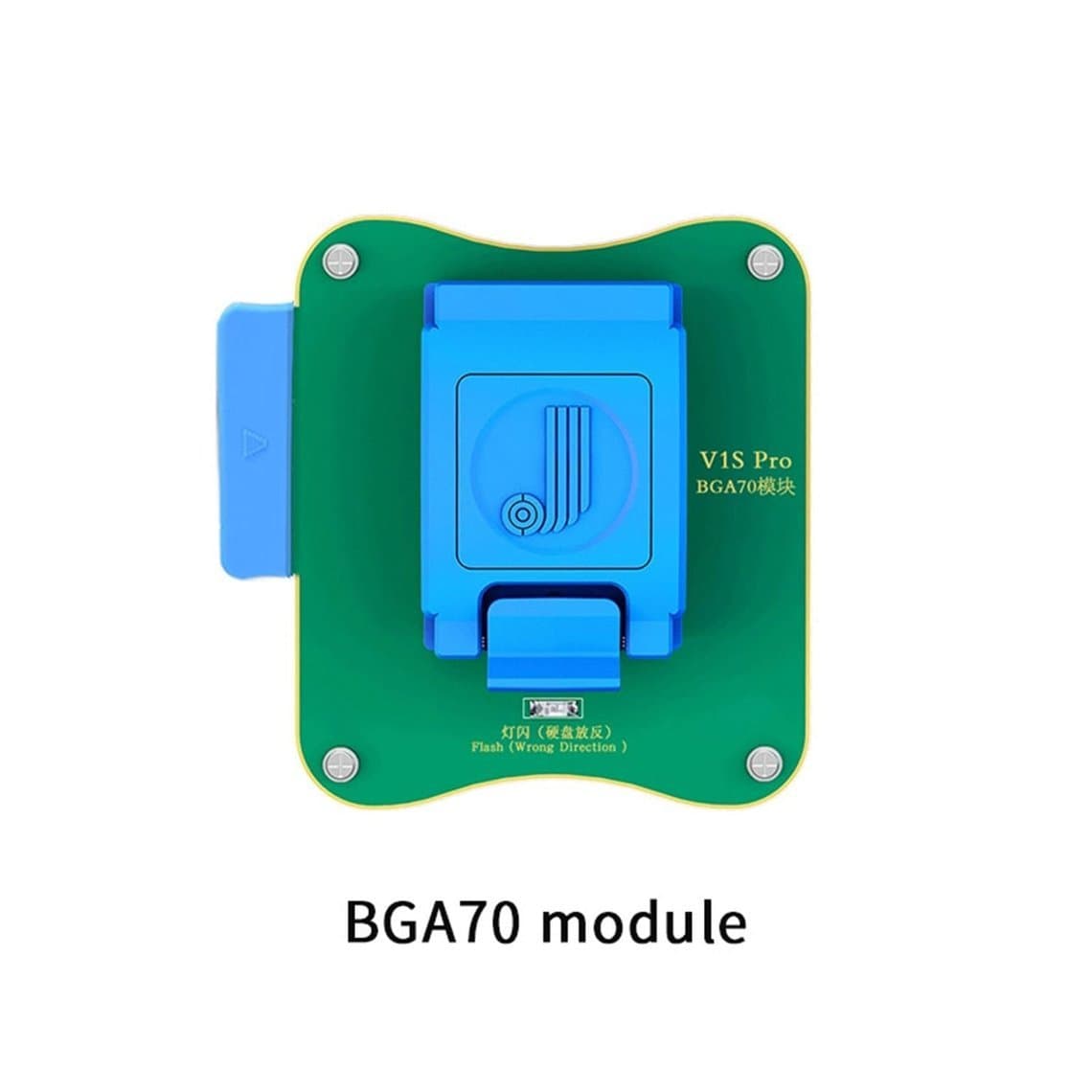
The V1S Pro is a modular platform. The base unit handles screen, True Tone, Face ID and battery work, and additional jobs are added with JCID functional modules for the V1S Pro. JCID also makes tag-on flexes for other modules, such as a tag-on wide-angle camera repair flex. If your shop does a broad mix of iPhone repairs, one ecosystem for several jobs keeps the bench simpler. Budget for modules and boards on top of the base unit.
i2C i6S
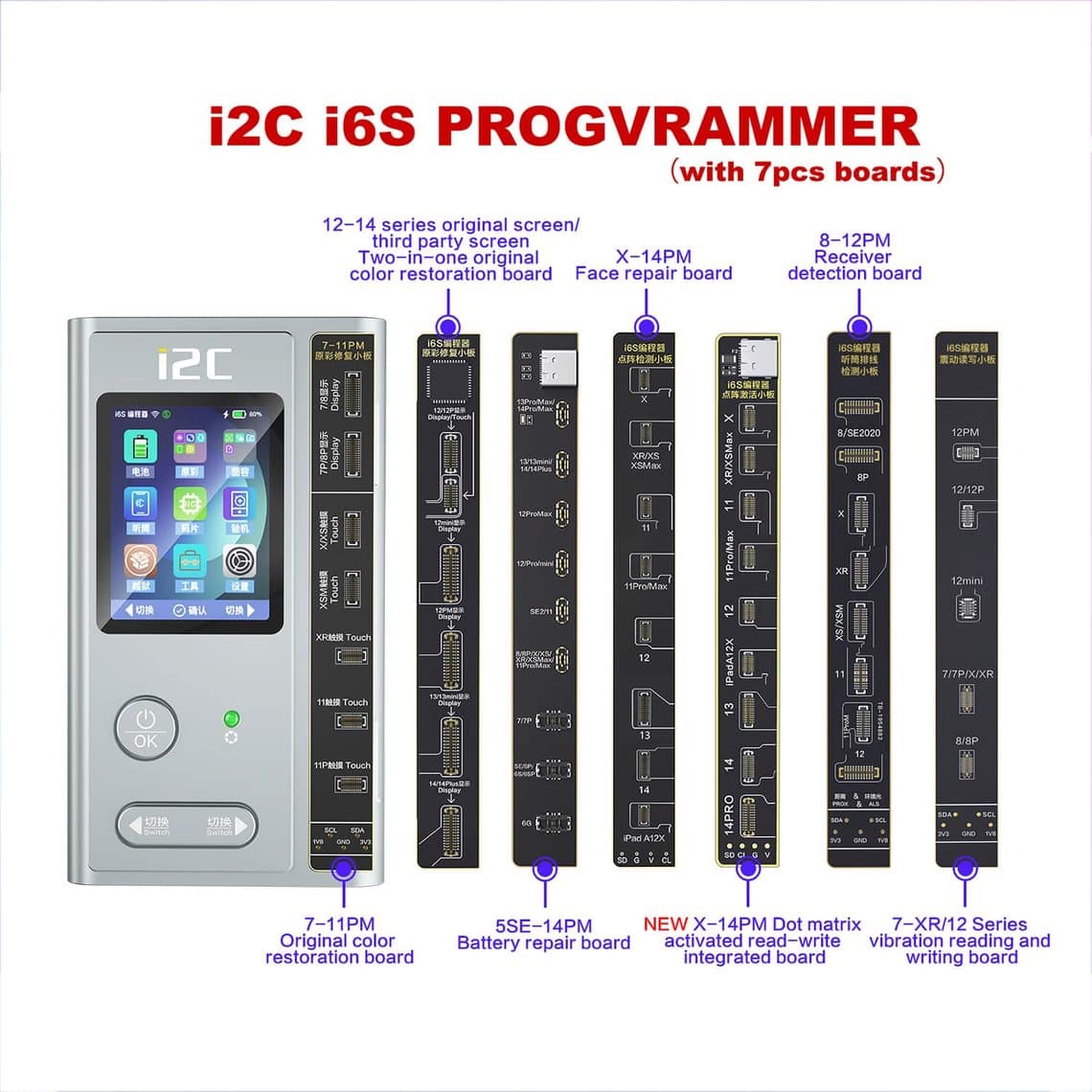
The i2C i6S covers True Tone, battery and dot matrix work, with its title stating iPhone 6 to 13. Add-on flexes such as an earpiece sensor flex extend it to other jobs. It is a sensible choice for shops whose work is mostly on those generations. For newer models, check whether i2C's current firmware supports battery work before relying on it.
Mijing ZH01
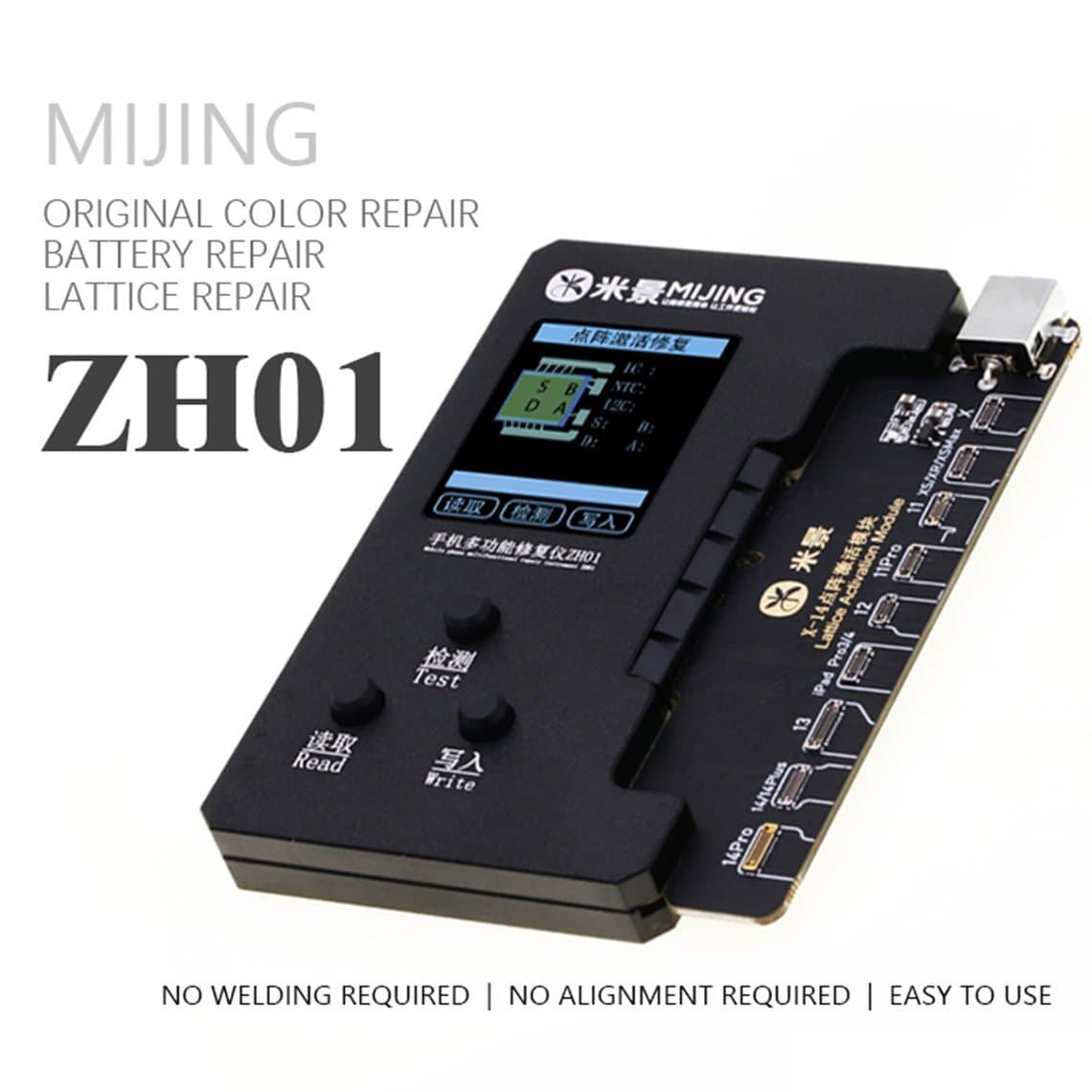
The Mijing ZH01 is a multi-function programmer aimed at dot matrix and battery repair. For batteries you need the battery repair flex cable for the ZH01, and camera work uses its own flex. Like the others, it is worth comparing the per-job cost of flexes, not only the price of the unit.
Qianli iCopy series
Qianli's iCopy programmers are known for LCD True Tone, light sensor and battery data. They suit shops that do a lot of screen work and want battery support in the same tool. Qianli also makes battery activation boards, covered below, which are a different kind of tool.
Activation and detection boards are not programmers
Battery activation boards such as the Qianli MEGA-IDEA iCharger and the Mechanic F918 wake up and check batteries. They are useful for testing a new cell before you fit it, or for reviving a battery that has dropped into protection mode. They do not copy battery data or restore the health display, so they complement a programmer rather than replace one.
How to choose
- List the models you see most. Match them against each tool's current battery compatibility list, not just the box title.
- Count the add-on cost per job. Flexes and tag-on boards are an ongoing expense. Multiply by your monthly battery volume.
- Think about other repairs. If you also do True Tone or Face ID work, one platform that covers them may beat a cheaper battery-only tool.
- Check software and updates. Support for new models comes through firmware. Find out how updates are delivered and whether an account or internet connection is needed.
- Stay with one ecosystem where you can. Flexes and boards are usually not interchangeable between brands.
Common mistakes and safety
- Not reading the original battery first. If the old battery is dead or damaged, you may not be able to read its data. Read before you remove it from the job tray.
- Expecting the notice to disappear on every model. Results depend on the model, the iOS version and the tool. On some models the health percentage returns but a parts notice can still appear in Settings.
- Misleading customers. Editing cycle count or health on a new cell is fine for restoring a correct reading. Do not use it to present a used battery as new.
- Unsafe spot welding. Use a proper spot welder, never a soldering iron directly on a cell, and work away from flammable materials.
- Skipping basic battery checks. Reject swollen, dented or hot cells. Disconnect the battery before working on the phone and use ESD protection.
For the full fitting process, see our iPhone battery replacement guide.
Questions
Can a programmer fix "Unknown part" for an iPhone battery?
On supported models, a programmer with a battery board can restore the battery health reading. Whether every notice disappears depends on the model and iOS version, so some phones may still list the battery as a non-genuine part. Check the tool maker's compatibility list for the exact model.
Do I need a battery flex for every battery replacement?
With the programmer method, yes: each new battery needs a compatible board or flex that the programmer can write to. Some batteries come with a board already fitted. The alternative is moving the original BMS onto a new cell, which needs a spot welder.
Which battery health programmer supports the most iPhone models?
Coverage changes with each firmware update and differs between battery, True Tone and Face ID functions. Compare the current published lists from JCID, i2C, Mijing and Qianli against the models you repair most, rather than relying on older reviews.
Can I reset an iPhone battery's cycle count?
Many programmers can edit the cycle count stored on a compatible battery board. This is meant for restoring a correct reading on a new cell. Changing it to make a used battery look new misleads the customer.
Browse battery health programmers and the full range of phone programmers, including JCID and i2C tools, and matching iPhone batteries, each tested before shipping. Wholesale prices unlock after $500 of purchases through a wholesale account, and you can reorder by SKU with Quick Order.