Fume Extractor for Soldering: A Guide for Repair Benches
17 November 2026 · LightspeedTools team
Short answer: A fume extractor for soldering pulls flux smoke away from your face and through a filter before it spreads around the room. For a phone repair bench, a desktop or microscope-mounted fan with a filter suits one technician, while busy shops with several stations often move to a larger purifier with arms or ducting. Place the intake close to the joint, replace filters on schedule, and follow your local workplace rules on ventilation.
Why fume extraction matters on a repair bench
The visible smoke from soldering is mostly burning flux, not vaporised metal. Flux fumes are known irritants for the eyes, nose and airways, and some people become more sensitive to them over time with repeated exposure. Rosin-based fluxes in particular are widely treated as a workplace respiratory hazard. Lead-free work tends to run hotter, which can increase how much flux smokes.
On a phone repair bench the problem is concentrated. You lean close to the board, often looking down a microscope, with hot air and an iron working the same small area for minutes at a time. Without extraction, the plume rises straight into your breathing zone.
Rules on workplace exposure and ventilation differ by country and region. Check what applies to your shop, especially if you employ staff. A fume extractor is one part of good practice, alongside general room ventilation, sensible flux use and washing your hands before eating. If you want to understand what is in the paste or gel you use, read our guide to flux for phone repair and check the safety data sheet for your product.
Types of fume extractor
| Type | How it works | Best for | Limits |
|---|---|---|---|
| Desktop fan with filter | Small box fan draws smoke through a filter pad and blows clean air out the back | Single bench, occasional to regular soldering | Must sit close to the work; small filters load up quickly |
| Microscope or magnetic mount | Compact fan clips or sticks near the lens or on a metal surface | Microscope work where a desktop unit gets in the way | Small fan and filter; needs regular cleaning |
| Iron with built-in extraction | Suction near the tip of the soldering iron | Capturing smoke right at the source during iron work | Does not cover hot air or preheater smoke |
| Purifier with arms or tubes | Larger cabinet with one or more flexible intake arms | Heavy use, multiple stations, hot air and BGA work | Bigger, louder, higher cost; filters cost more |
| Ducted system | Ducting carries fumes to a central unit or outside | Shops with many benches | Needs installation and planning |
Desktop units
The classic bench extractor is a small fan housing with a filter on the front. Examples include the 2UUL UuFilter desktop fume extractor and the 220V desktop fume extractor with on/off switch. They are cheap to run and easy to move between benches. Their weakness is reach: a desktop unit placed at the back of the bench catches little.
Microscope and magnetic mounts
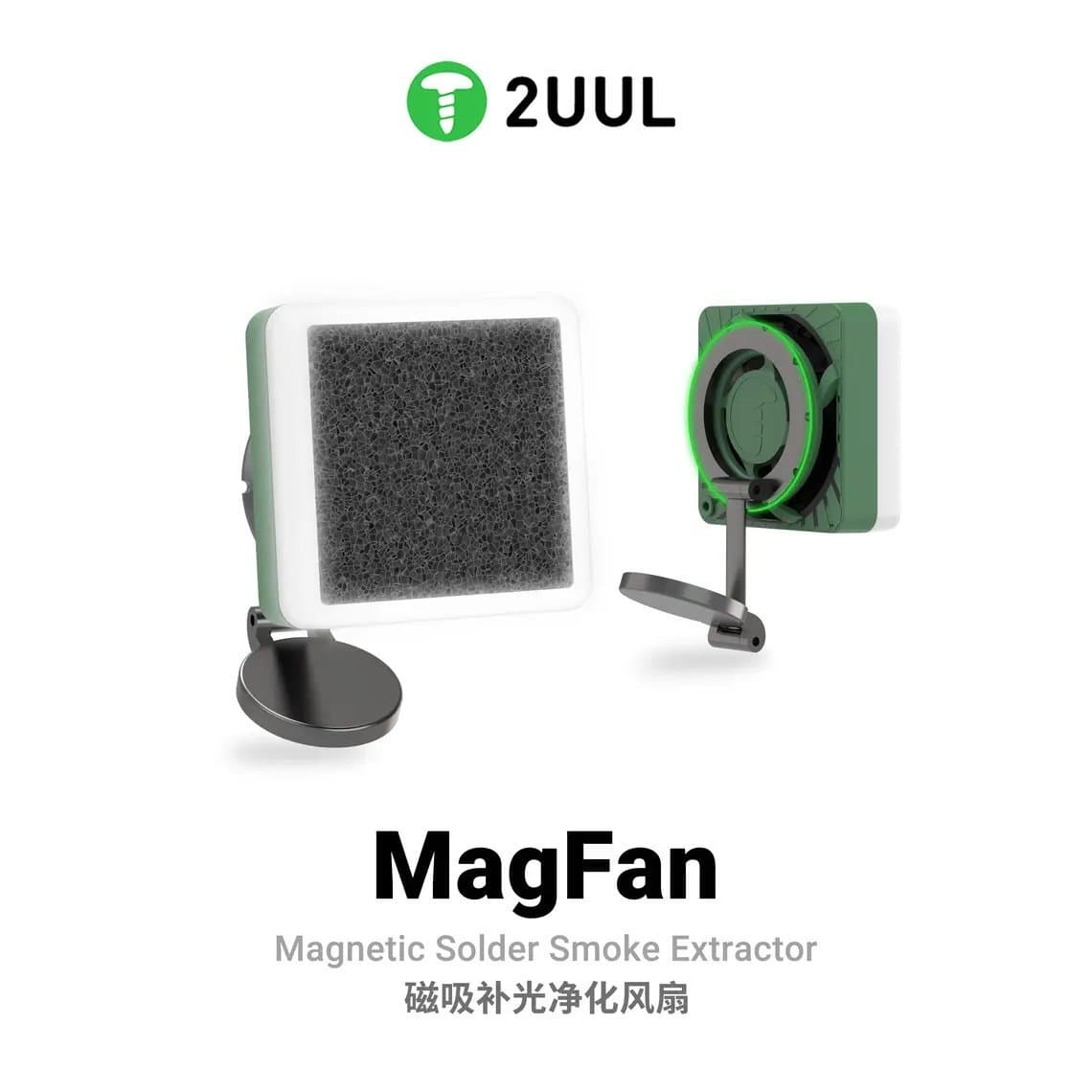
Under a microscope there is little space for a box fan. Compact units mount near the lens or attach magnetically, such as the 2UUL FE11 MagFan magnetic smoke extractor and the Kaisi mini microscope exhaust fan. A side benefit is that they stop smoke from drifting up and fogging the objective lens.
Extraction at the iron
An iron with suction near the tip, like the TBK D201 soldering iron with fume extractor, captures smoke right where it forms. It is useful for long iron jobs but does nothing for hot air work, so most benches still need a separate extractor. For choosing the iron itself, see our guide to the best soldering station for mobile repairing.
Larger purifiers and multi-station systems
When a bench runs hot air and preheaters all day, or several technicians share a room, a larger purifier with flexible arms is easier to live with. The Quick 6601 soldering smoke purifier, the double and single tube smoke purifier and the TBK-805 soldering and laser smoke purifier are this kind of unit. Arms let you aim the intake at the job, and a multi-tube unit can serve two positions. For a room full of benches, a ducted system planned with a ventilation installer is the long-term answer. If you also run laser machines, see laser fume extractors, since laser smoke has its own demands.
Filters: what they do
Filters are where extractors differ most, and listings often say little. In general:
- Pre-filter. A coarse pad that catches larger particles and protects the main filter.
- Particle filter. Finer media, sometimes rated as HEPA on larger units, that traps fine smoke particles.
- Activated carbon. Adsorbs some gases and odours that particle filters let through. Carbon is common on small bench units, often as a single pad.
A single carbon pad on a small fan mainly reduces odour and visible smoke; multi-stage filtration on a larger purifier captures more. Check the filter description for the exact unit you buy rather than assuming every extractor has every stage. If the listing does not state the filter type, ask before ordering.
Filter replacement
- Replace on the maker's schedule, or sooner under heavy use.
- Signs a filter is spent: weaker airflow, smoke escaping around the intake, a stronger smell, visible discolouration.
- Carbon cannot be cleaned back to life. Once it is saturated, it stops working even if it looks fine.
- Keep spare filters in stock. Buying the extractor and its filters from the same range avoids fit problems.
- Bag used filters and dispose of them according to local rules, since they hold flux residue.
Placement: close to the source
Capture falls off quickly with distance. A small fan that works well a few centimetres from the joint may do very little from the far end of the bench. Practical placement rules:
- Put the intake as close to the joint as you can without it getting in the way of your hands or tools.
- Position it so smoke is drawn away from your face, not across it.
- Angle it slightly above and to the side of the work, where the plume naturally rises.
- Check that the outlet does not blow into a colleague's breathing zone or onto another bench.
- Move the intake as the job moves; a fixed arm aimed at the wrong side of the board does little.
Using extraction with hot air and preheaters
Hot air work creates a different problem. Strong suction near the nozzle can pull heat away from the joint, cool the board unevenly, and even shift small parts such as capacitors and resistors.
- Set the intake a little further back or lower the fan speed during hot air work.
- Do not aim the extractor directly at the nozzle stream.
- Preheaters bake flux slowly and give off a steady haze. Leave the extractor running for the whole preheat.
- Run the extractor for a short time after the job ends; flux keeps smoking while the board cools.
Read more on airflow and nozzle choice in our hot air station buying guide, or browse hot air rework stations and PCB preheaters.
Noise, power and practical details
- Noise. Fans are noisy at full speed. A unit with speed control lets you run quiet for iron work and turn it up for heavy flux.
- Voltage. Check the stated voltage and plug type. Some units are 220V only; buy the version that matches your mains.
- Switching. An easy-to-reach on/off switch means it actually gets used.
- Size. Measure the space under and around your microscope before buying.
- ESD. Keep the extractor housing away from exposed boards, and keep the bench grounded.
- Fire safety. Never point a hot air nozzle at the filter, and never leave lit equipment unattended near a loaded filter.
Common mistakes
- Placing the extractor at the back of the bench where it captures almost nothing.
- Running the same filter for months until airflow drops to nothing.
- Using a small odour-only fan for all-day hot air and BGA work.
- Pointing strong suction at a hot air job and blowing parts off the board.
- Treating an extractor as a substitute for room ventilation.
- Using far more flux than the joint needs, which makes far more smoke.
Questions
Do I really need a fume extractor for soldering?
For regular soldering, yes. Flux smoke is an irritant and you breathe it at close range on a repair bench. Local workplace rules may also require extraction or ventilation, so check what applies to your shop.
Does a fume extractor remove lead?
Soldering smoke is mostly flux; solder at normal working temperatures gives off very little metal vapour. The bigger lead risk is from handling solder and dross, so wash hands and keep food off the bench. Particle filtration helps with fine smoke, but check the filter stages of the unit you buy.
How often should I change the filter?
Follow the maker's schedule and replace sooner under heavy use. Weak airflow, a stronger smell or escaping smoke are signs the filter is spent. Carbon filters cannot be cleaned and reused once saturated.
Can a fume extractor affect hot air rework?
Yes. Strong suction near the nozzle can cool the joint unevenly or move small parts. Set the intake further back or reduce fan speed during hot air work, and keep it running while the board cools.
See the full range of fume extractors, along with soldering stations and flux for a complete bench. Shops equipping several benches can unlock wholesale pricing, and reorders of filters and consumables are quickest through Quick Order.